




CEO or head of people
Needs to trust the reasoning behind a leadership hire.
For CEOs and people leaders hiring senior roles. Every candidate is measured against your current brief, with the evidence in plain view.
Shortlist, evidence and client report in one place, always tied to the brief that applies now.
Senior roles where the problem is specific and a wrong hire is expensive.
What happens at each stage, and what you receive.
We define the problem. You approve it.
Approved briefWe map the market and approach in confidence.
Weekly written updateEvidence and gaps for every candidate.
Evidence per candidateA partner-reviewed report. Your call.
Partner-reviewed reportWe write it. You approve it before anyone is approached.
| Integration | 12 sites | Start | |
|---|---|---|---|
Each gap becomes a question to ask, not a score.
A partner signs it off. The decision stays yours.
A 45-minute first call. You leave with an outline brief.
Four fields. Two minutes.
45 minutes with your named consultant.
In writing, for you to approve or change.
Leadership decisions, grounded in evidence.
How the Mandate Studio identity looks and speaks, on the website and in the workspace, in light and dark.
One ribbon that rises, folds and rises again. It reads as an M and as a line that moves forward.
Leave half the mark's height clear on every side.
Mark 20 px tall. Horizontal lockup 120 px wide.
Blue and green only. Ink and mist carry the page, Electric Blue and Aqua are for action and focus, Seafoam and Mint only light things up.
#0B1117RGB 11 17 23Text and dark canvas#2F6BFFRGB 47 107 255Primary actions and links#00C6BBRGB 0 198 187Focus and progress#7FF2CBRGB 127 242 203Highlights on dark#D9FBE6RGB 217 251 230Tints on lightElectric Blue to Aqua to Seafoam. Used on primary buttons, the logo and light effects, never behind body text.
#EDF3F6#FFFFFF#0B1117#576173#007A73#2A5FF0 → #00857E#0B1117#121B25#F2F5FA#96A1B3#2FD8CC#4D82FF → #00C6BBDocumented, to verify and too late use their own green, amber and red, so a status never looks like a brand accent.
One display face, one interface face.
Headlines and the wordmark. ExtraBold 800 for MANDATE, Regular 400 with wide tracking for STUDIO, Black 900 for headlines.
Everything people read and click: body text, labels, buttons, data.
The mark on a rounded square: ink and blue in dark, mist in light.
Liquid glass over soft light: frosted panels, a fine bright edge, generous corners.
Calm, exact and on the client's side. We say what we know, how we know it, and what is still open.
“Ran two sites directly. The other ten are still to verify.”
“The client still has to confirm the start date.”
“Top candidate, 92% match.”
“Perfect fit, ready to start.”
The same identity across the website and the workspace.
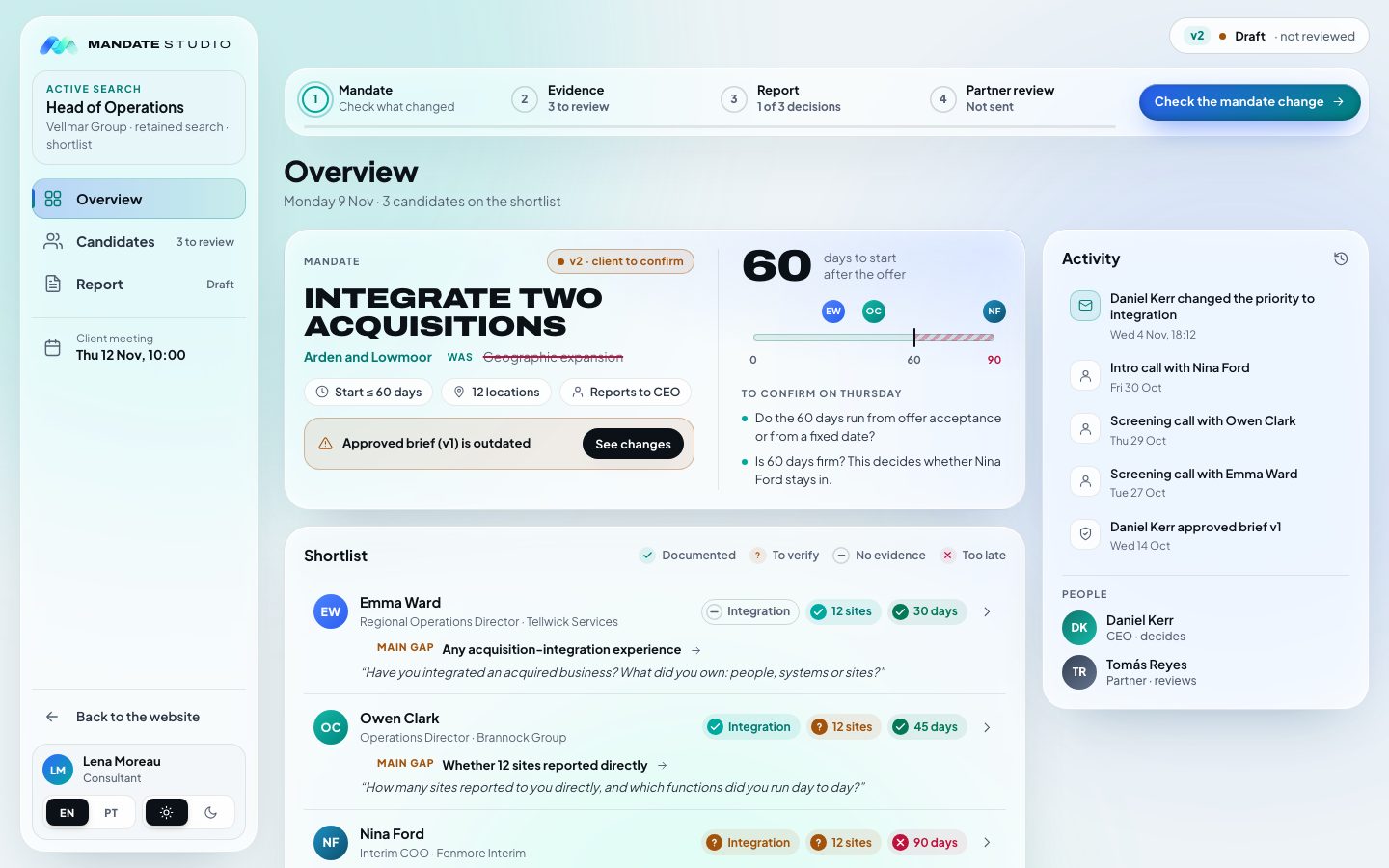
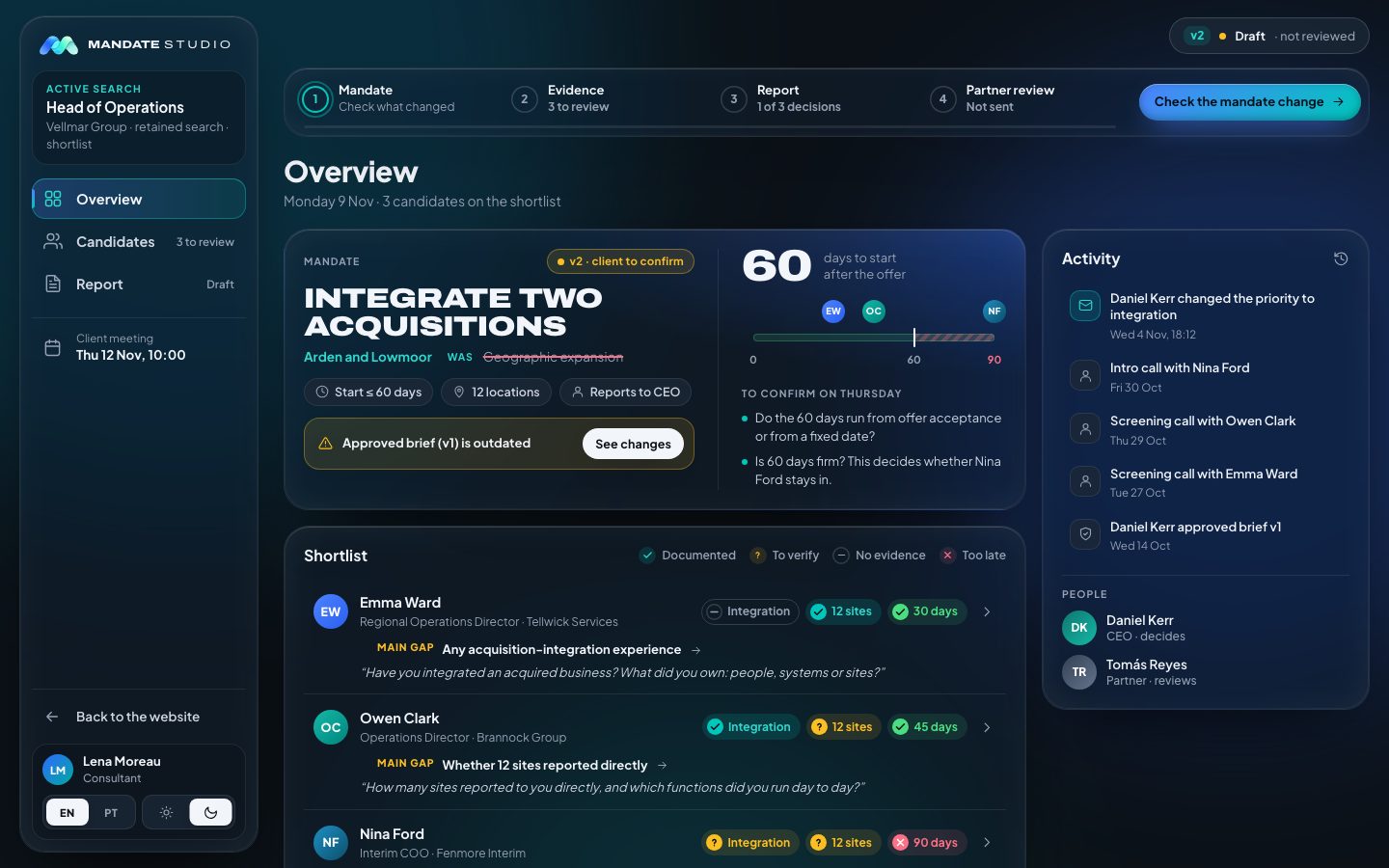
Mandate Studio brand guidelines.
A homepage for a retained-search firm and a recruiting workspace where a consultant evaluates three candidates against a changed brief and sends a client report for partner review.
Needs to trust the reasoning behind a leadership hire.
Changing brief, thin notes, a meeting on Thursday. Needs a credible report without stale approvals.
Shown as review states and names, not separate dashboards.
The approved brief (v1) says expansion. The board now wants two acquisitions integrated. Three candidates, uneven notes, one can’t start in 60 days.
| Assumption | To clarify with the client |
|---|---|
| Assumption 60 days run from offer acceptance | Offer date or a fixed calendar date? |
| Assumption An approval belongs to one version | Does the client also sign off the report? |
| Assumption Availability is self-reported | Confirm notice periods. |
| Assumption Sector and names are fictional | Are acquired sites part of the twelve? |
Candidates A, B and C from the brief appear as Emma Ward, Owen Clark and Nina Ford. Profile details beyond the brief are invented and leave the central gaps open.
| Rejected | Chosen | Cost |
|---|---|---|
| Fit score per candidate | Evidence state per criterion + next question | No single “winner” to scan for |
| One “approved” flag per document | Approval tied to a version number | More versions, one confirm step |
| Step-by-step document wizard (v1) | Dashboard with three sections | Less guidance, so a progress bar |
| Separate Candidates and Compare screens | One screen, candidates side by side | Wide layout; cards swipe on phones |
| Red for “no evidence” | Grey for absence, red only for “too late” | Gaps look calmer than they are; text label added |
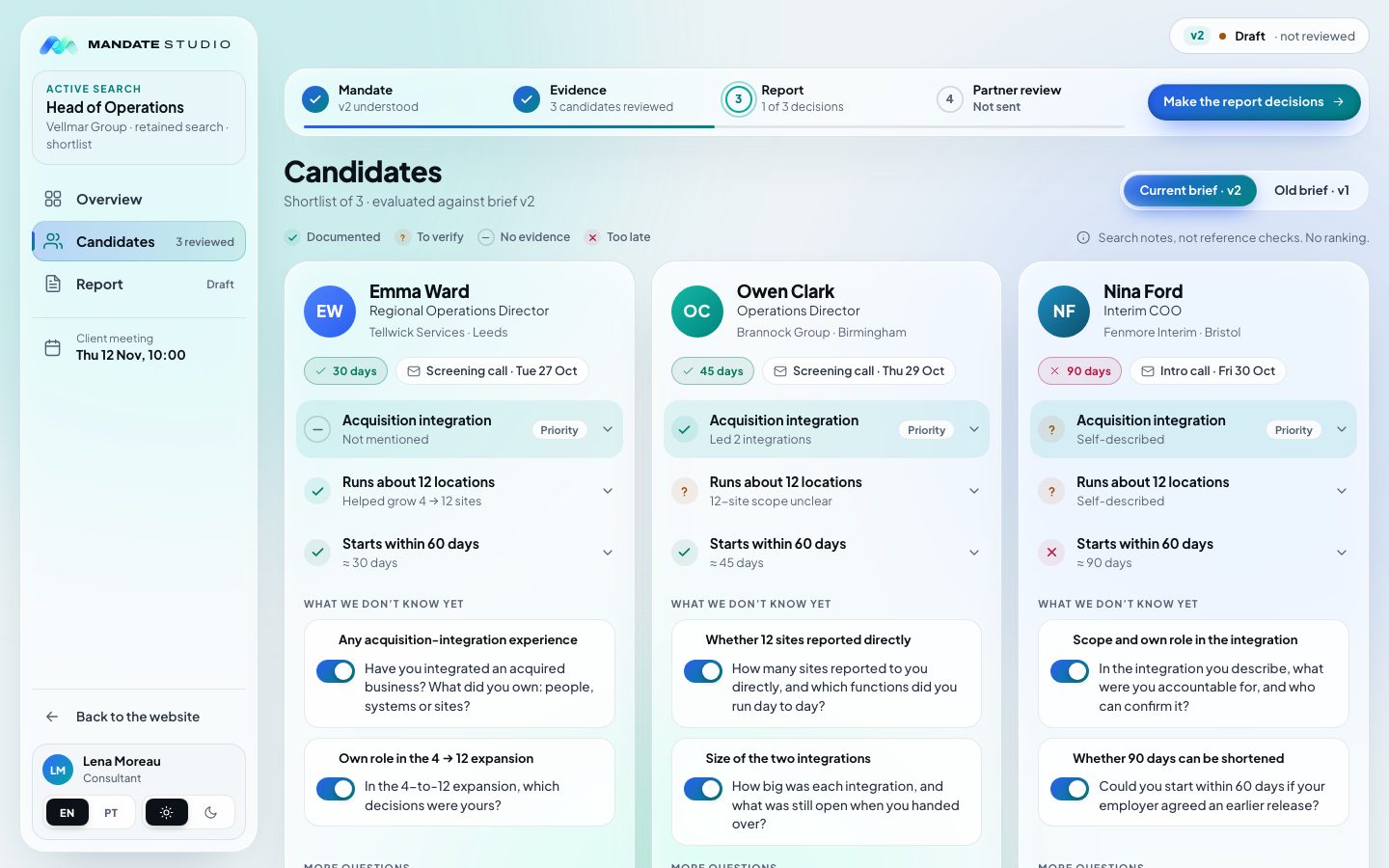
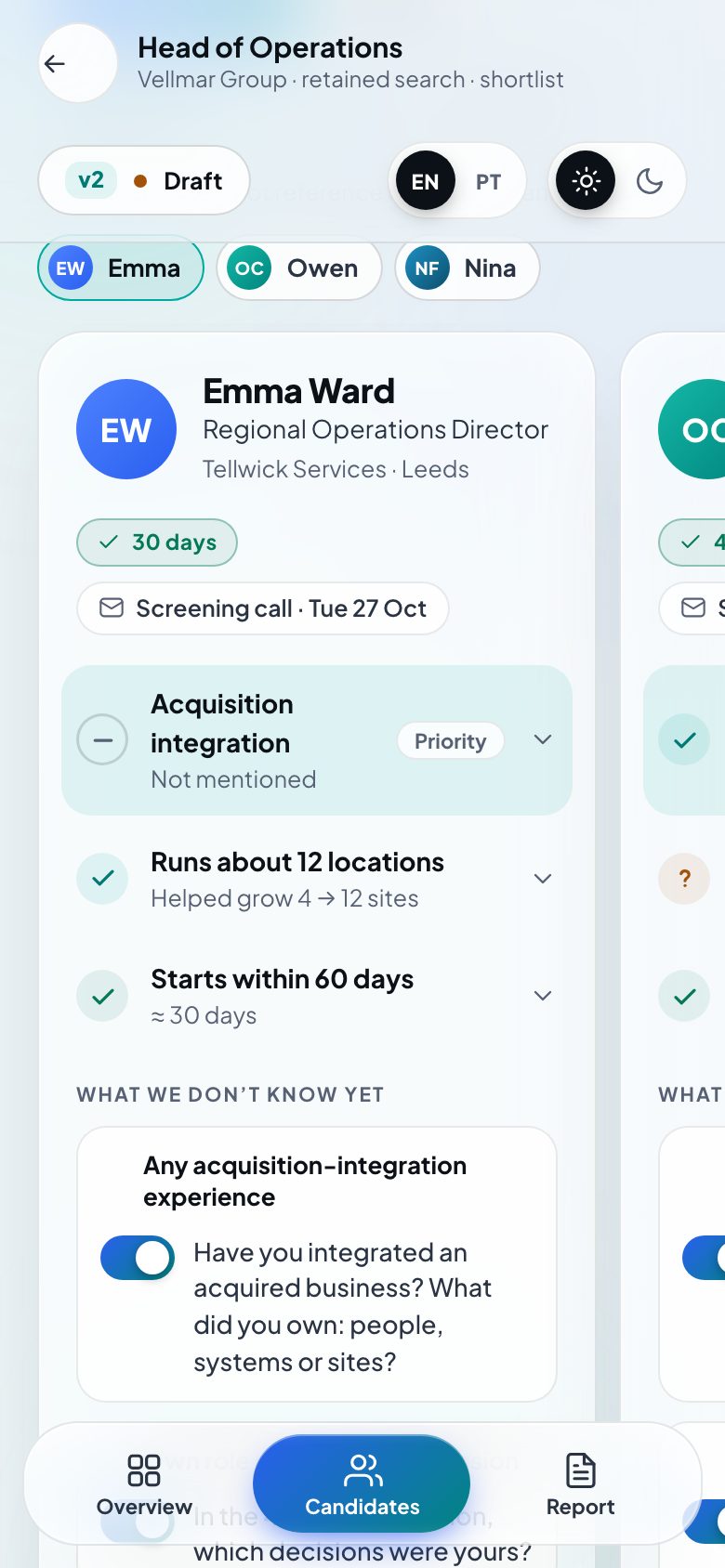
“How many sites reported to you directly?”
Performed Self-review only. No participants.
| Step | What the screen shows |
|---|---|
| Open assignment | “Approved brief (v1) is outdated” on the mandate card; progress starts at Mandate |
| Understand priority | v1 → v2 changes, Daniel’s email, 60-day window |
| Compare | Emma, Owen and Nina side by side; one click shows them against the old brief |
| Send too early | “2 things missing · nothing was sent”, rows highlighted and shake |
| Send | Stepper on Partner review; “not approved yet” |
| Edit / restore | New version as draft; the approval seal stays with its version |
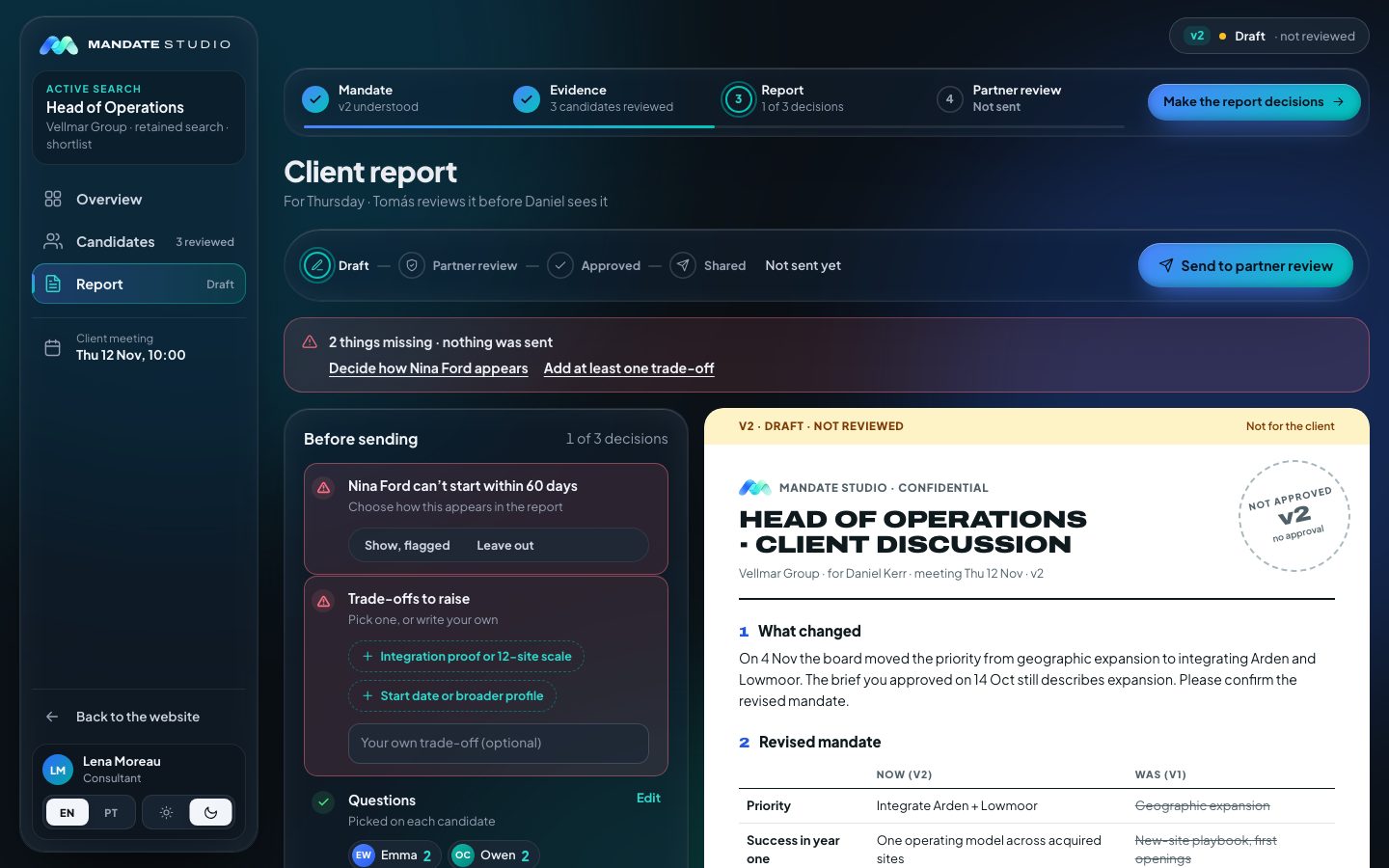
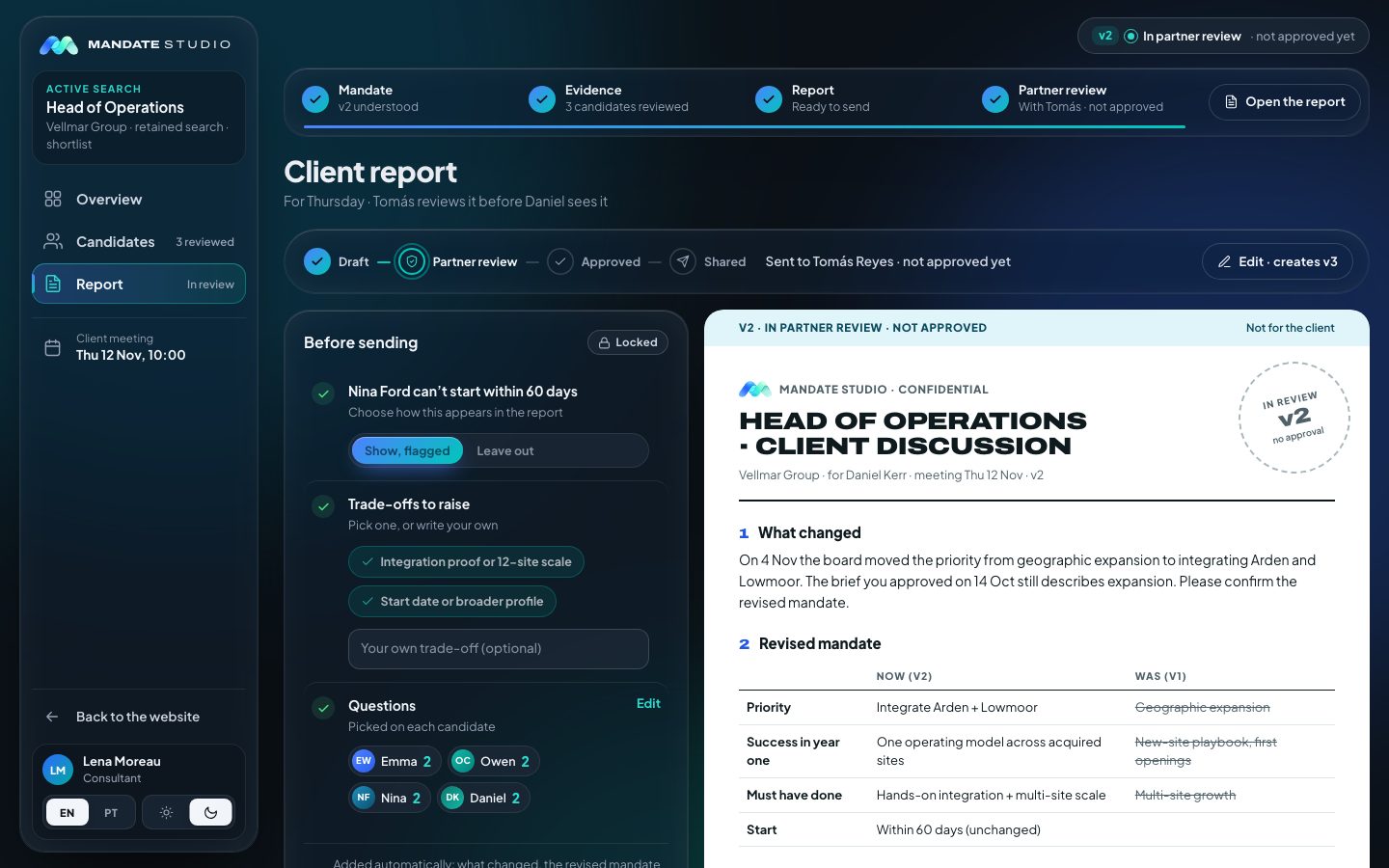
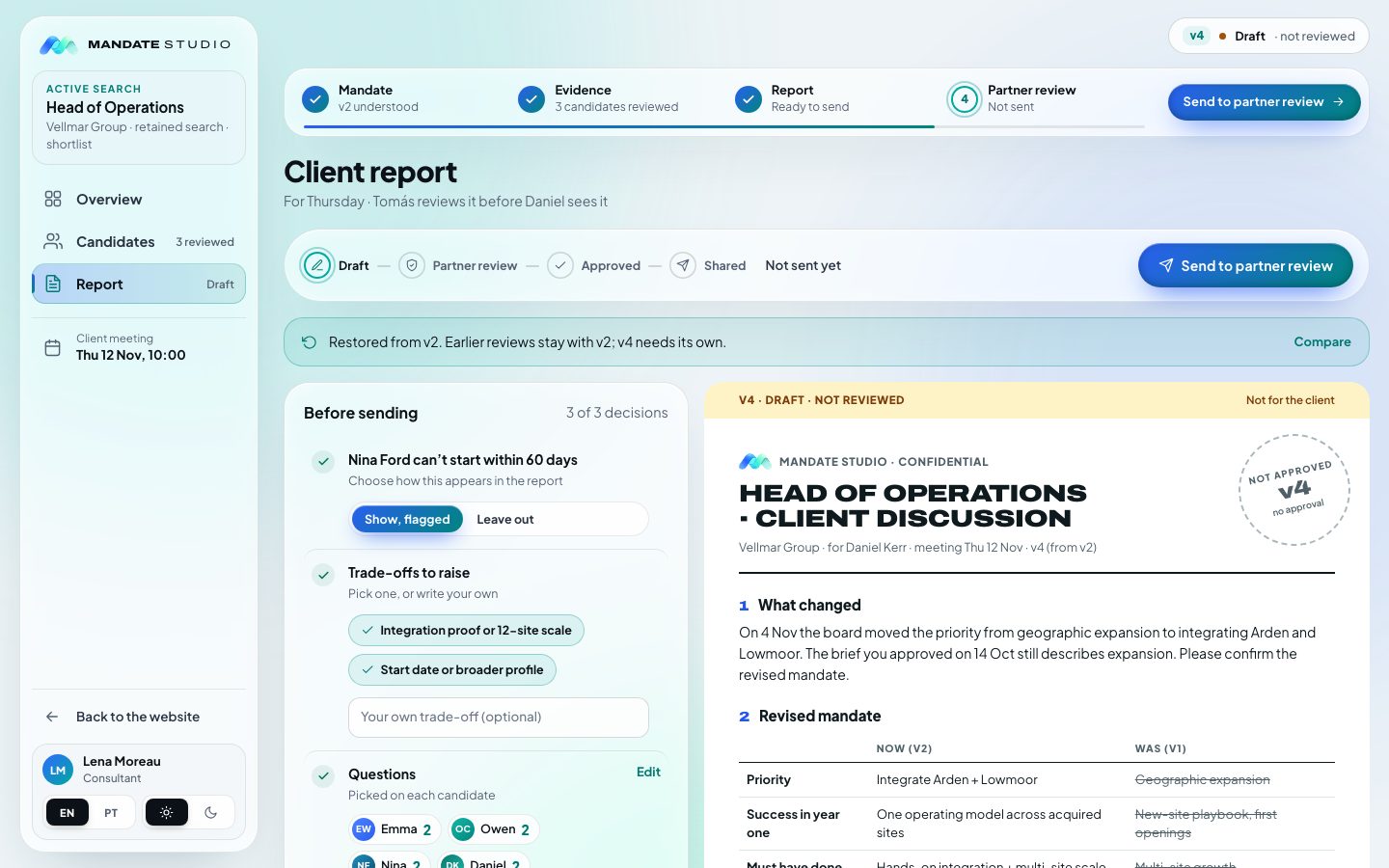
390, 1024, 1440 px, both themes. No sideways scroll.
All text tokens AA. Lowest 4.7:1, body 10.6–18.4:1.
Focus ring, labels, native dialogs, alert on errors.
Five consultants, 20 minutes, success defined in advance.
Performed Three rounds. The first version was a four-step wizard that read like a document. The second became a dashboard. The third merged candidates and comparison, named the people and paired each gap with its question.
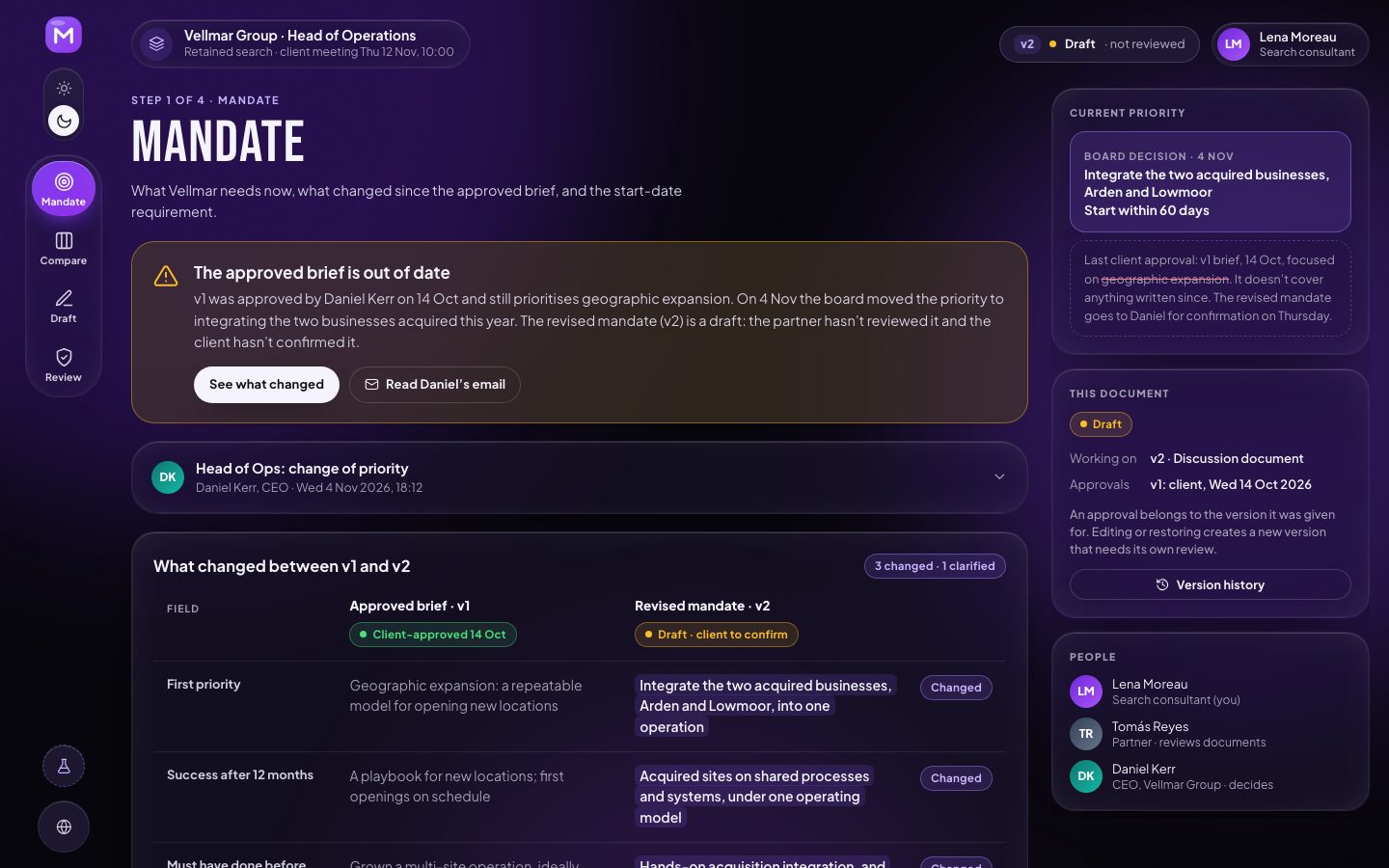
Where do old approvals get reused today: emails, PDFs, decks?
Version-matched sharing
Reports shared = exact version the partner approved. Target 100%.